Beauty of Joseon Relief Sun Review: Honest 30-Day Test (2026)
If you’ve spent five minutes on SkinTok in the past year, you’ve seen the pale mint tube. Beauty of Joseon Relief Sun is the K-beauty sunscreen that turned a under-$20 drugstore-priced bottle into a global cult object — and yes, it’s still selling out on Amazon every summer.
I tested this for a full month going into the warm season — Texas-grade sun, office AC, walks, makeup days, no-makeup days. Here’s the honest breakdown: what makes it special, what it absolutely isn’t (a beach sunscreen), and the one thing American shoppers should understand before buying.
Check current price on Amazon →
What it actually is
A 50ml tube of lightweight chemical sunscreen formulated with rice extract, niacinamide, panthenol, and a probiotic ferment complex. SPF 50+ PA++++ — the highest UV protection grades available under the Korean and Japanese rating systems.
The texture is the easiest way to understand why this product blew up. It’s not the chalky, white-cast SPF most Americans grew up hating. It’s a thin milky cream that melts in within seconds, leaves a soft dewy finish, and somehow doesn’t pill under foundation.
The UV filters are where things get interesting:
- Uvinul A Plus (Diethylamino Hydroxybenzoyl Hexyl Benzoate) — broad UVA protection
- Uvinul T 150 (Ethylhexyl Triazone) — UVB
- Tinosorb M (Methylene Bis-benzotriazolyl Tetramethylbutylphenol) — broad UVA + UVB, photostable
- Iscotrizinol (Diethylhexyl Butamido Triazone) — UVB + UVA II, super photostable
If those names mean nothing to you, here’s the short version: these are newer-generation chemical filters that Asian and European sunscreens use, but most American sunscreens don’t. They’re more photostable, less likely to break down in sunlight, and rarely leave a white cast. We’ll come back to why this matters in a second.
Beauty of Joseon Relief Sun: Rice + Probiotics SPF 50+ PA++++
Editor’s Pick
Type: Chemical sunscreen + skincare
SPF: 50+ PA++++
Skin type: Normal / dry / combination / sensitive
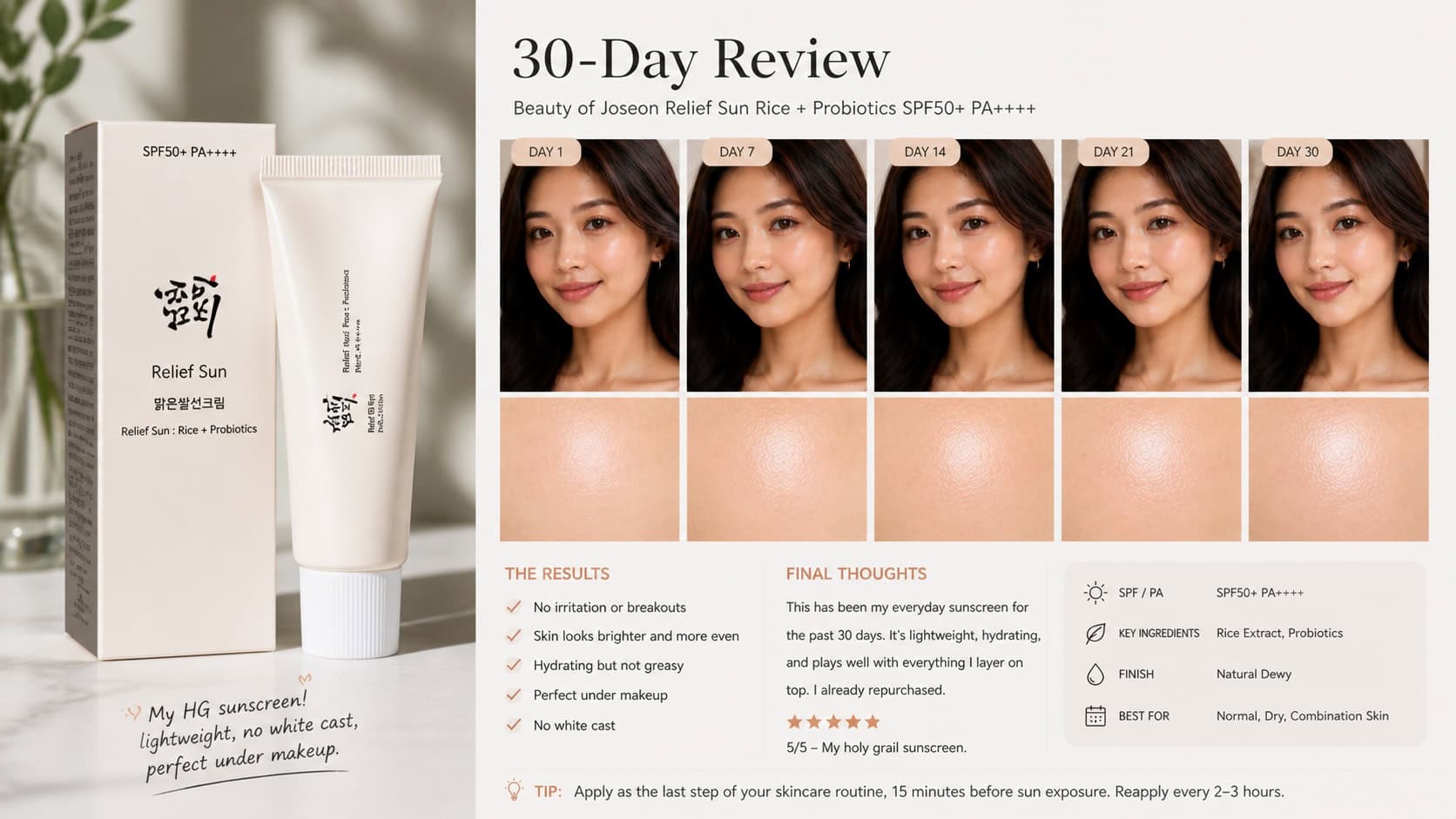
After 30 days of daily use, what stuck with me wasn’t just the protection — it was that I actually wanted to wear sunscreen every morning. The texture is somewhere between a moisturizer and a serum, finishing dewy without being greasy. On no-makeup days, my skin looked like it was wearing a soft tinted moisturizer. On makeup days, foundation laid down clean.
The catch: this is an everyday SPF, not a beach or sport sunscreen. It’s not water-resistant, it’s not sweat-proof, and on humid afternoons or after a workout, you’ll get shiny. If your daily life is offices, errands, walks, and short sun exposure between buildings, it’s near-perfect. For pool days, swap it out.
- Genuinely zero white cast — works on all skin tones
- Lightweight dewy finish, layers under makeup without pilling
- Modern UV filters with strong UVA protection
- Fragrance-free formula
- under $20 price point — hard to beat for the formula quality
- Niacinamide + rice extract for added hydration and tone
- Not water or sweat resistant — daily wear only
- Too dewy for very oily skin in humid weather
- 50ml tube goes faster than you’d expect with proper application
- UV filters not FDA-approved (legal to import, but worth knowing)
The FDA filter question — what American buyers should know
This is the part most Amazon reviews skip, and I think it matters.
The UV filters in Relief Sun (Uvinul A Plus, Tinosorb M, Iscotrizinol, Uvinul T) are approved and widely used in Korea, Japan, the EU, Australia, and most of the world. They are not currently approved by the US FDA — not because they’re unsafe, but because the FDA hasn’t updated its sunscreen regulations to include modern filters in over two decades.
What this means in practice: it’s completely legal to buy and use Relief Sun in the United States. Amazon US sells it directly, Sephora carries it, and dermatologists who follow international research often recommend Korean and European sunscreens specifically because of these newer filters. The protection is real and the formulas are arguably more advanced than what’s available in standard US sunscreens.
If you prefer to stick with FDA-approved active ingredients only, this is not your sunscreen. If you want the photostable, non-chalky, broad-spectrum protection that the rest of the world has been using for years, this is exactly why you’d buy it.
How to use it
- Cleanse, tone, and moisturize as usual.
- Apply two-finger-lengths for the full face — about 1.25ml. Less than this and you’re not getting the labeled SPF protection. This is the most common mistake people make with sunscreen.
- Pat, don’t rub. Press it into skin in sections rather than spreading thin.
- Wait 60 seconds before applying makeup. Trying to layer foundation while it’s still wet causes pilling.
- Reapply every 2–3 hours if you’re outdoors. For desk-and-commute days, once in the morning is realistic for most people.
Who should buy it — and who shouldn’t
Buy if:
- You have normal, dry, combination, or sensitive skin
- You’ve hated every white-cast sunscreen you’ve ever tried
- You wear makeup and need a base that won’t pill
- You want strong daily UVA + UVB protection without paying under $50 for it
- You’re comfortable with non-FDA-approved filters used worldwide
Skip if:
- Your skin is very oily and gets shiny by noon (try Beauty of Joseon Relief Sun Aqua-Fresh: Rice + B5 instead — same brand, oil-friendly version)
- You need a beach, swim, or sports sunscreen
- You only buy FDA-approved active ingredients on principle
- You’re sensitive to chemical UV filters (look at mineral options like SKIN1004 instead)
How it compares to American sunscreens
The honest comparison: Relief Sun feels closer to a French pharmacy sunscreen (La Roche-Posay Anthelios, Avène) than to typical American drugstore SPF. The texture is lighter, the cosmetic finish is better, and the UV filter blend is more modern.
The closest American comparison is Supergoop Unseen Sunscreen, which has a beautiful velvety finish — but it’s SPF 40 vs. 50+, costs around 2.5x more, and uses different filters. For everyday wear under makeup, Relief Sun gives you more protection at a lower price.
For sensitive or reactive skin, Relief Sun is also one of the few high-SPF chemical sunscreens that’s fragrance-free, alcohol-free, and includes calming ingredients (rice extract, panthenol, green tea, ginseng). That combination is genuinely hard to find at this price.
Frequently asked questions
Relief Sun vs Daily Tinted Fluid — which Beauty of Joseon SPF should you buy?
Relief Sun is the one everyone knows. The tinted version solves a different problem, and for a lot of people it is the better daily bottle.
Beauty of Joseon Daily Tinted Fluid Sunscreen (12 Shades, SPF 40) — if you want SPF and light coverage in one step — twelve shades, so you can match rather than settle for a grey cast. Read the full shade guide → Check current price on Amazon →
Bottom line: Relief Sun if you wear makeup over it. Tinted Fluid if you would rather skip the makeup entirely.
The verdict
If you’ve been hunting for an everyday sunscreen that actually feels good to wear, layers under makeup, and protects properly without breaking under $25 Beauty of Joseon Relief Sun is one of the strongest picks on Amazon right now. It’s not perfect — not for the beach, not for very oily skin in summer humidity — but for daily life it earns its hype. After a month of testing, it’s still in my morning routine.