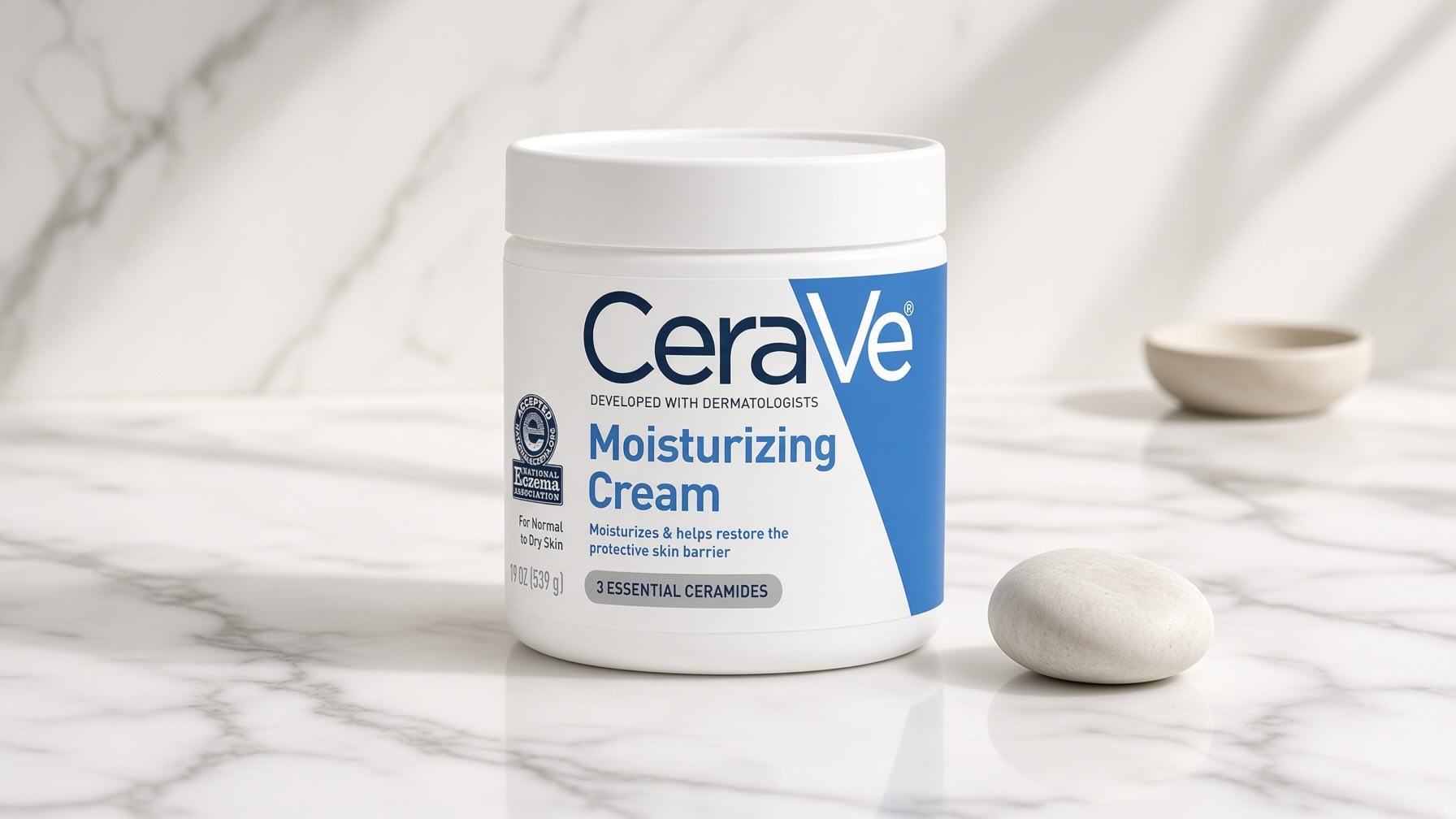
CeraVe Moisturizing Cream Review: The Fall Skin Barrier Reset Every Dermatologist Recommends (2026)
CeraVe Moisturizing Cream is the most consistently recommended moisturizer by dermatologists in the United States — and in 2026, it remains the #1 reader-repurchased moisturizer for sensitive skin across Amazon beauty surveys. After eight weeks of daily use as both a face and body moisturizer through the summer-to-fall transition, I understand why it has held this position for years while dozens of trendy alternatives have cycled in and out. CeraVe Moisturizing Cream is not exciting. It is correct — and in moisturizers, correct beats exciting every single time.
This review covers CeraVe Moisturizing Cream from the angle that matters most in August and September: the fall skin barrier transition. As temperatures drop and indoor heating begins, the skin’s hydration needs shift dramatically. CeraVe Moisturizing Cream — with its ceramide-and-hyaluronic-acid barrier repair formula — is specifically what dermatologists recommend for this seasonal shift. This is not just a product review. It is an explanation of what ceramides actually do, why the skin barrier matters more in fall than at any other time of year, and why this tub belongs in every skincare routine heading into autumn.
Contents
Quick Verdict
Best for: Dry to normal skin transitioning into fall — barrier repair, sustained hydration, and the ideal base for retinoids and actives in the cooler months.
Skip if: You have oily or acne-prone skin — the rich formula can feel too heavy; use CeraVe PM Lotion instead.
Editor score: 9.5 / 10
Price tier: Around $18 for 16oz tub
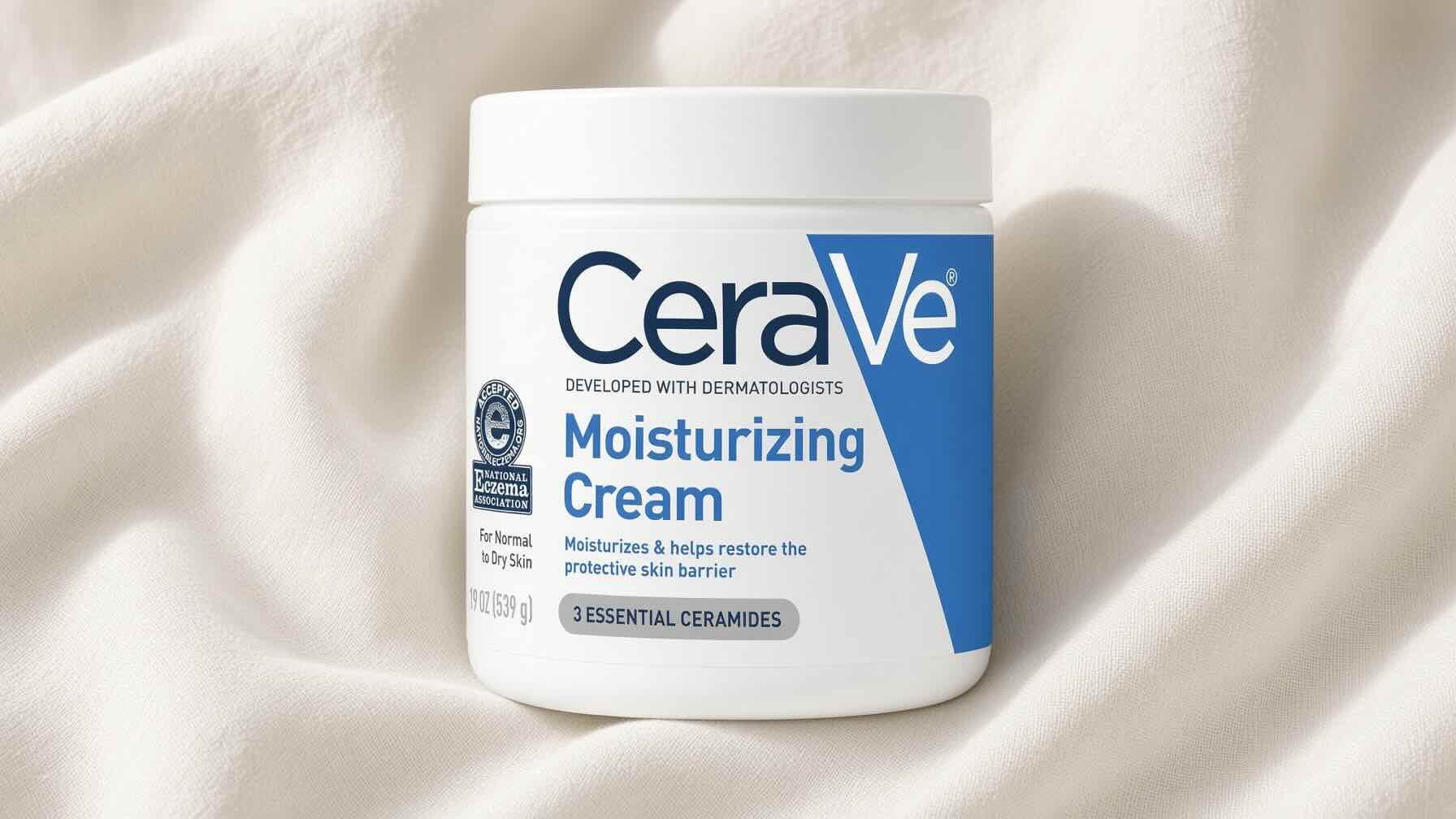
CeraVe Moisturizing Cream — full review
CeraVe Moisturizing Cream (16oz Tub)
Key ingredients: Ceramides 1, 3, 6-II + Hyaluronic Acid + Niacinamide
Technology: MVE (MultiVesicular Emulsion) — timed-release hydration
Texture: Rich cream — heavier than a lotion, lighter than a balm
Use: Face and/or body, AM and PM
Formula: Fragrance-free, non-comedogenic, National Eczema Association accepted
Skin type: Dry to normal; sensitive-safe; eczema and rosacea appropriate
Why we picked it
CeraVe Moisturizing Cream earns its dermatologist-recommendation status through formulation quality, not marketing spend. The formula was developed in collaboration with dermatologists specifically to address ceramide deficiency — the underlying cause of dry, irritated, and barrier-compromised skin. Three types of ceramides (1, 3, and 6-II) in a ratio that mirrors the skin’s own ceramide composition, hyaluronic acid at three molecular weights for both surface and deep hydration, and niacinamide for barrier strengthening and tone — all delivered through CeraVe’s patented MVE technology that releases the actives gradually over 24 hours rather than all at once.
What makes CeraVe Moisturizing Cream the correct August-to-fall purchase is the timing of the skin’s needs. Summer skin is in a humidity-assisted hydration mode — ambient moisture in the air supplements the skin’s own moisture retention. When temperatures drop in late August and September, the ambient humidity decreases, indoor heating begins, and the skin suddenly has to maintain its own moisture levels without environmental assistance. Ceramide-deficient skin — which most summer-compromised skin is — cannot do this adequately, leading to the dry, tight, reactive skin that many people experience every autumn. CeraVe Moisturizing Cream is the proactive barrier repair that prevents this from happening.
Pros
- Three ceramides in a skin-matching ratio — genuine barrier repair, not surface coating
- MVE technology — 24-hour timed-release hydration, not a single burst
- Fragrance-free — safe for the most reactive, sensitive, or eczema-prone skin
- National Eczema Association accepted — independently verified gentle enough
- Face and body dual use — one product replaces both face moisturizer and body lotion
- #1 dermatologist-recommended moisturizer — earned through formulation, not marketing
- 2026 reader #1 repurchased moisturizer for sensitive skin
Cons
- Too rich for oily or acne-prone skin — use CeraVe PM Lotion instead
- Tub format requires clean hands or a spatula — not hygienic for finger-dipping
- No SPF — must be paired with a separate daily sunscreen in AM use
- Not a treatment product — does not address pigmentation, fine lines, or acne directly
What ceramides do — the barrier science
The skin barrier and ceramides
The skin barrier — technically the stratum corneum — is often described as a brick-and-mortar structure: skin cells (corneocytes) are the bricks, and a lipid matrix of ceramides, cholesterol, and fatty acids is the mortar holding them together. Ceramides make up approximately 50% of this lipid matrix, making them the dominant structural component of the barrier. When ceramide levels are depleted — by UV exposure, over-exfoliation, harsh cleansers, cold weather, or aging — the mortar between the bricks breaks down, allowing moisture to escape through the gaps (transepidermal water loss, or TEWL) and irritants to enter. The skin becomes dry, tight, reactive, and more vulnerable to everything from pollution to retinoid irritation.
Why replenishing ceramides works
Topical ceramides replenish the depleted lipid matrix by integrating into the existing barrier structure — they are not just a surface moisturizing film but are structurally incorporated. CeraVe uses three specific ceramides (1, 3, 6-II) because different ceramide types perform different structural roles within the barrier, and this combination most closely matches the ratio found in healthy young skin. The result of consistent ceramide application is a measurably stronger barrier that retains moisture better, is less reactive to actives and environmental stressors, and recovers faster from any disruption. For background on the role of ceramides in skin health, the American Academy of Dermatology’s moisturizer guidance covers the barrier science clearly.
The MVE timed-release advantage
CeraVe’s patented MVE (MultiVesicular Emulsion) technology encapsulates the moisturizing ingredients in a series of concentric spheres that rupture progressively over 24 hours, releasing ceramides, hyaluronic acid, and niacinamide in timed waves rather than all at once. This is the mechanism behind the genuine 24-hour moisturization claim — most moisturizers release all their actives within the first hour of application and then provide only a residual film effect. MVE genuinely delays and extends the release, which is why consistent morning-only CeraVe use provides measurable hydration at bedtime — 16+ hours after application.
How to use CeraVe in the fall transition routine
The AM fall routine: CeraVe as the moisturizer foundation
Cleanse → treatment serum (niacinamide, vitamin C) → CeraVe Moisturizing Cream → SPF. In fall, CeraVe replaces the lightweight gel moisturizers that work in summer — the richer ceramide formula provides the barrier reinforcement that humidity previously assisted with. Allow 3–5 minutes to absorb before applying SPF. The cream sits well under both mineral and chemical SPF formulas without pilling.
The PM fall routine: CeraVe as the retinoid buffer
As you introduce or intensify retinoid use in fall (Differin, retinol), CeraVe Moisturizing Cream is the most effective buffer. The “sandwich method” for retinoid introduction: cleanse → CeraVe → wait 5 minutes → retinoid → CeraVe. The ceramide base creates a moisture buffer that significantly reduces retinoid irritation while still allowing the retinoid to reach the skin. This protocol is specifically recommended for anyone starting Differin Adapalene Gel in the fall skin transition period.
Body use: the transition from summer lotion
In summer, lightweight body lotions (eos Shea Better) are appropriate for the skin’s hydration needs. In fall, switch to CeraVe Moisturizing Cream for body use — apply to still-damp post-shower skin, focusing on arms, legs, and any areas prone to eczema flares. The 16oz tub provides approximately 3–4 months of body use at once-daily application. This makes CeraVe one of the most cost-efficient body moisturizers for fall and winter use.

My 8-week results
Who should use CeraVe Moisturizing Cream
Use it if:
- You have dry, normal, or sensitive skin that needs barrier repair heading into fall
- You are introducing or intensifying retinoid use and need the best buffer available
- You have eczema, rosacea, or reactive skin that cannot tolerate fragrance or harsh ingredients
- You want one tub that covers both face and body moisturizing needs
- You have been using a lightweight summer moisturizer and need to transition to something richer
- You want the dermatologist-validated choice without paying a luxury price
Skip it if:
- You have oily or acne-prone skin — use CeraVe PM Facial Moisturizing Lotion or CeraVe AM with SPF instead
- You want SPF included in your moisturizer — add EltaMD UV Daily on top
- You prefer a very lightweight, water-gel texture — the cream format will feel heavy on oily skin
CeraVe vs other moisturizers
CeraVe Moisturizing Cream vs Vanicream Moisturizing Cream
Vanicream is the other dermatologist-recommended fragrance-free moisturizer for sensitive skin, using a simpler formula without ceramides. For the most reactive skin that needs absolute minimal ingredient lists, Vanicream is the safer choice. For skin that needs active barrier repair through ceramide replenishment rather than just surface hydration, CeraVe is more effective because of its ceramide content.
CeraVe Moisturizing Cream vs La Roche-Posay Cicaplast Baume B5 ($20)
La Roche-Posay Cicaplast Baume B5 is a concentrated skin repair balm with panthenol for accelerated healing — better for compromised, actively irritated, or post-procedure skin. CeraVe is a daily maintenance moisturizer for intact but dry or barrier-depleted skin. Use Cicaplast for acute skin repair phases (post-peel, post-procedure, active flare-up) and CeraVe for the daily maintenance that prevents flare-ups from occurring.
CeraVe Moisturizing Cream vs Cetaphil Moisturizing Cream
Cetaphil Moisturizing Cream is the closest competitor — also dermatologist-recommended, fragrance-free, and suitable for sensitive skin. Cetaphil uses a simpler emollient base without ceramides. CeraVe’s ceramide content gives it a meaningful advantage for actual barrier repair vs simply moisturizing the surface. Both are excellent choices; CeraVe is the better option when barrier repair is the goal rather than simple comfort hydration.
FAQ
Can CeraVe Moisturizing Cream be used on the face and body?
Yes — it is formulated for both face and body use. The non-comedogenic formula means it will not clog pores when used on the face, and the ceramide content makes it equally effective for body barrier repair. Using one tub for both face and body is the most economical approach — the 16oz size provides several months of combined use.
Is CeraVe Moisturizing Cream safe for eczema?
Yes — CeraVe Moisturizing Cream has received the National Eczema Association Seal of Acceptance, which is independently verified for safety and appropriateness on eczema-prone skin. It is one of the most frequently recommended moisturizers by dermatologists for eczema management because ceramide replenishment directly addresses the ceramide deficiency that underlies most eczema flares.
Should I use CeraVe in the morning or evening?
Both — CeraVe Moisturizing Cream is appropriate for AM and PM use. In the AM, apply before SPF as your moisturizer base. In the PM, apply after cleansing and any treatment actives (or use the sandwich method around retinoids). For maximum barrier repair, twice-daily use produces results faster than once-daily. If cost or quantity is a concern, prioritize PM use when the skin does most of its barrier repair.
Does CeraVe Moisturizing Cream clog pores?
CeraVe Moisturizing Cream is non-comedogenic — independently tested to not clog pores. For most normal-to-dry skin types, it does not cause breakouts. However, for very oily or acne-prone skin, even non-comedogenic rich creams can feel heavy and contribute to congestion. If you have oily or acne-prone skin, use CeraVe PM Facial Moisturizing Lotion instead — a lighter version with the same ceramide technology.
How is CeraVe Moisturizing Cream different from CeraVe Daily Moisturizing Lotion?
The Moisturizing Cream (tub) is a richer, thicker cream with higher emollient content — best for dry skin, body use, fall and winter, and as a retinoid buffer. The Daily Moisturizing Lotion (pump bottle) is a lighter formula with less emollient — better for normal skin, face-only use, and warmer months. Both contain the same ceramide and MVE technology; the difference is texture and richness level. For fall barrier repair, the Cream is the correct choice.
Final verdict — CeraVe Moisturizing Cream
CeraVe Moisturizing Cream is the most important moisturizer you can add to your fall skincare routine in 2026. It is not exciting — it is a white cream in a tub that smells like nothing and costs $18. What it does is repair the ceramide-depleted skin barrier that summer leaves behind, support retinoid introduction without irritation, and provide genuine 24-hour hydration through MVE technology that most moisturizers cannot replicate. Eight weeks of daily use delivered the best barrier condition I have had heading into any fall season. The dermatologist recommendation is not marketing — it is the accurate conclusion from the formula.